6 min read
AI Search
Generative Engine Optimization
How to Get Cited in AI Answers
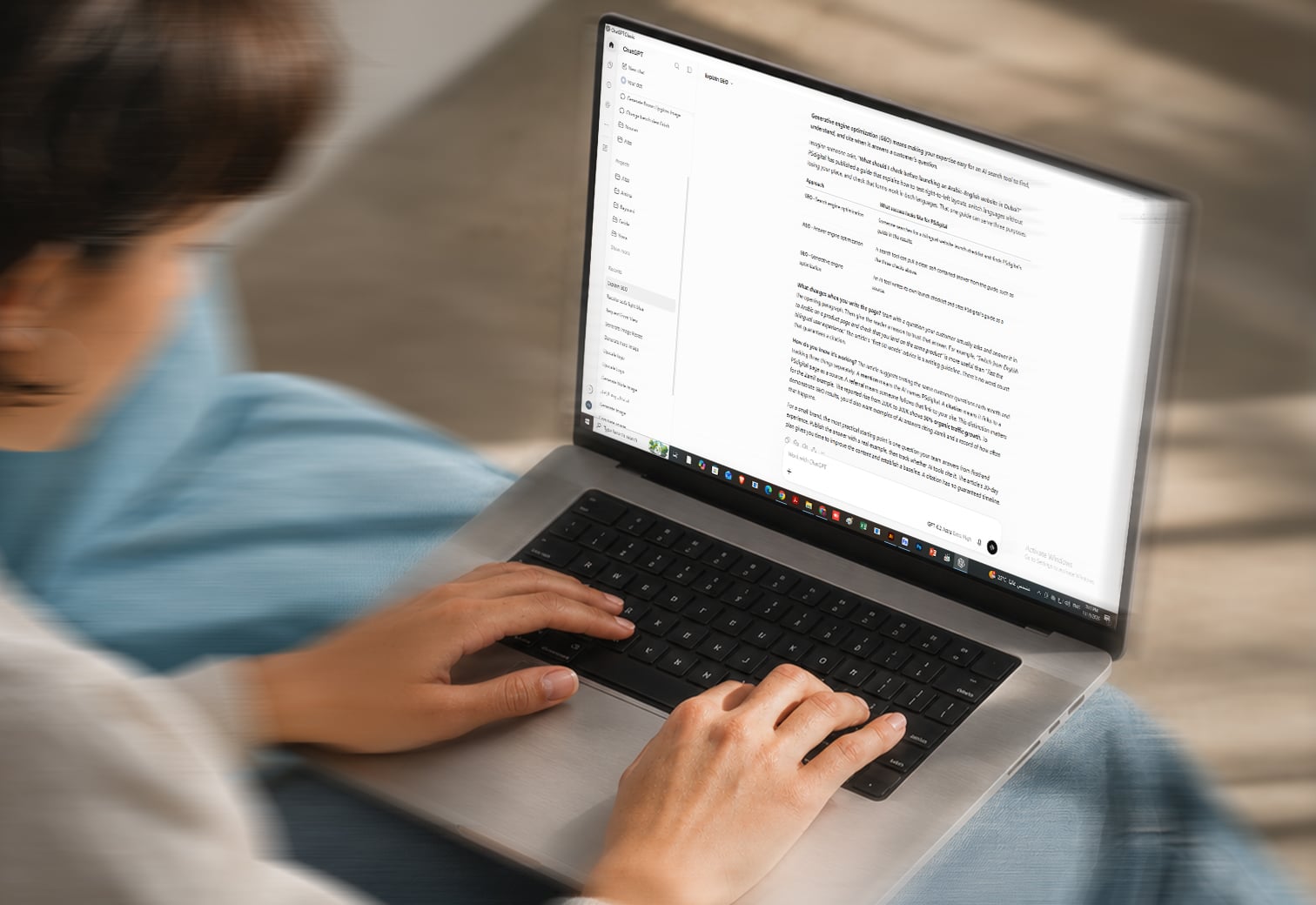 A laptop in blue tones with a search bar and result cards hovering in layers above the keyboard.
What is generative engine optimization?
Generative engine optimization (GEO) is how you shape your pages and your brand so AI search tools pick you as a source when they write an answer. Classic SEO fights for a position in a list of links. GEO fights to be one of the two or three sources an answer actually quotes.
- The goal: a mention, a citation or a link inside the AI answer.
- The unit of work: a passage that answers one question clearly, not a whole page.
- The test: would a model be comfortable quoting this sentence without checking it?
GEO, AEO and SEO: what is different?
The terms overlap, and the overlap is where most teams get confused. AEO (answer engine optimization) is the older label, from the days of featured snippets and voice assistants. GEO is the newer one, aimed at generative tools. The work is close to identical, and none of it replaces SEO.
- SEO earns the crawl, the index and the ranking.
- AEO shapes content so it can be lifted as a direct answer.
- GEO adds the brand and trust signals that make a model name you.
Search data shows where the interest sits. Semrush shows "generative engine optimization" at around 9,900 monthly searches in the US, while "aeo" has 480 in the UAE. In the Gulf, the older term still carries the local demand, so use both in your copy.
How to get cited by ChatGPT, Gemini and AI Overviews
Nobody can promise a citation. What you can do is remove the reasons a model would skip you. These habits work across the main tools.
Answer the question in the first 60 words
Put the direct answer right under the heading, in plain sentences. Then add detail below. A model scanning your page for one passage should find it without reading three paragraphs of context.
Write headings that sound like real questions
People ask AI tools full questions, so headings such as "How much does a website cost in Dubai?" match better than "Pricing overview". Keep one topic per page so the match stays clean.
Back every claim with something checkable
Use figures, dates and named sources. "Organic traffic grew from 200K to 300K" can be quoted. "We drive great results" cannot. If you cannot support a number, leave it out.
Make the page easy to read for machines
- Use one H1, then H2 and H3 in order.
- Prefer short paragraphs and bullet lists over long blocks.
- Add Organization, Article and FAQ structured data that matches the visible text.
- Keep pages fast and crawlable, and check that robots.txt does not block the AI crawlers you want. Common ones include OAI-SearchBot, PerplexityBot and Google-Extended.
Make your brand easy for AI to recognise
A model has to be confident about who you are before it names you. That confidence comes from consistency across the web, not from one page.
- Use the same brand name, address, email and social profiles everywhere.
- Keep your Google Business Profile and LinkedIn page current.
- Earn mentions on sites your audience trusts: industry press, partner pages, awards and directories.
- Name real people. An article written by a named expert with a role and a profile reads as more reliable than one with no author.
For Zamil Real Estate, our SEO work combined search-led content with structure that helps the developer appear in AI answers on Google and Gemini. Organic traffic grew from 200K to 300K, and the site now shows on Google page one.
AI Overviews and AI Mode in the Gulf
Google launched AI Overviews in the Middle East and North Africa in May 2025, and AI Mode followed in English across the region on 21 August 2025. For Gulf brands this has two practical effects. English answers are already live, and bilingual brands should publish Arabic and English versions of key pages so each language has its own quotable passages.
How to measure AI search visibility
Traffic alone under-counts GEO, because many AI answers satisfy the user without a click. Track these instead:
- A fixed prompt list. Pick 20 to 30 questions your buyers ask, and run them monthly in each tool.
- Mention and citation rate. Count how often your brand is named, and how often your URL is linked.
- Referral traffic. Check analytics for visits from AI tools, and how they convert.
- Accuracy. Note where an answer describes you wrongly, then fix the source page.
Answers shift as models and sources change, so review monthly and avoid reading too much into a single run.
A starting plan for the next 30 days
- Week 1: list your 20 priority questions and check who gets cited today.
- Week 2: rewrite the five most important pages answer-first, with a named author and dates.
- Week 3: add structured data, fix crawl issues and align brand profiles.
- Week 4: publish one source-worthy piece with original numbers, then re-run your prompt list.
Frequently asked questions
No. AI tools draw on indexed, trusted pages, so the SEO basics still decide whether you are in the pool. GEO adds the work that makes a model choose you from it.
Want to know where your brand stands in AI answers? Start a project with PSdigital and we will audit your priority questions.
Sources: Google, AI Mode in English across MENA (21 August 2025); Semrush keyword data (US and UAE databases, October 2026).
Keep reading
Moreinsights


Let's build yournext move
Bring the brief, and we'll take it from there.